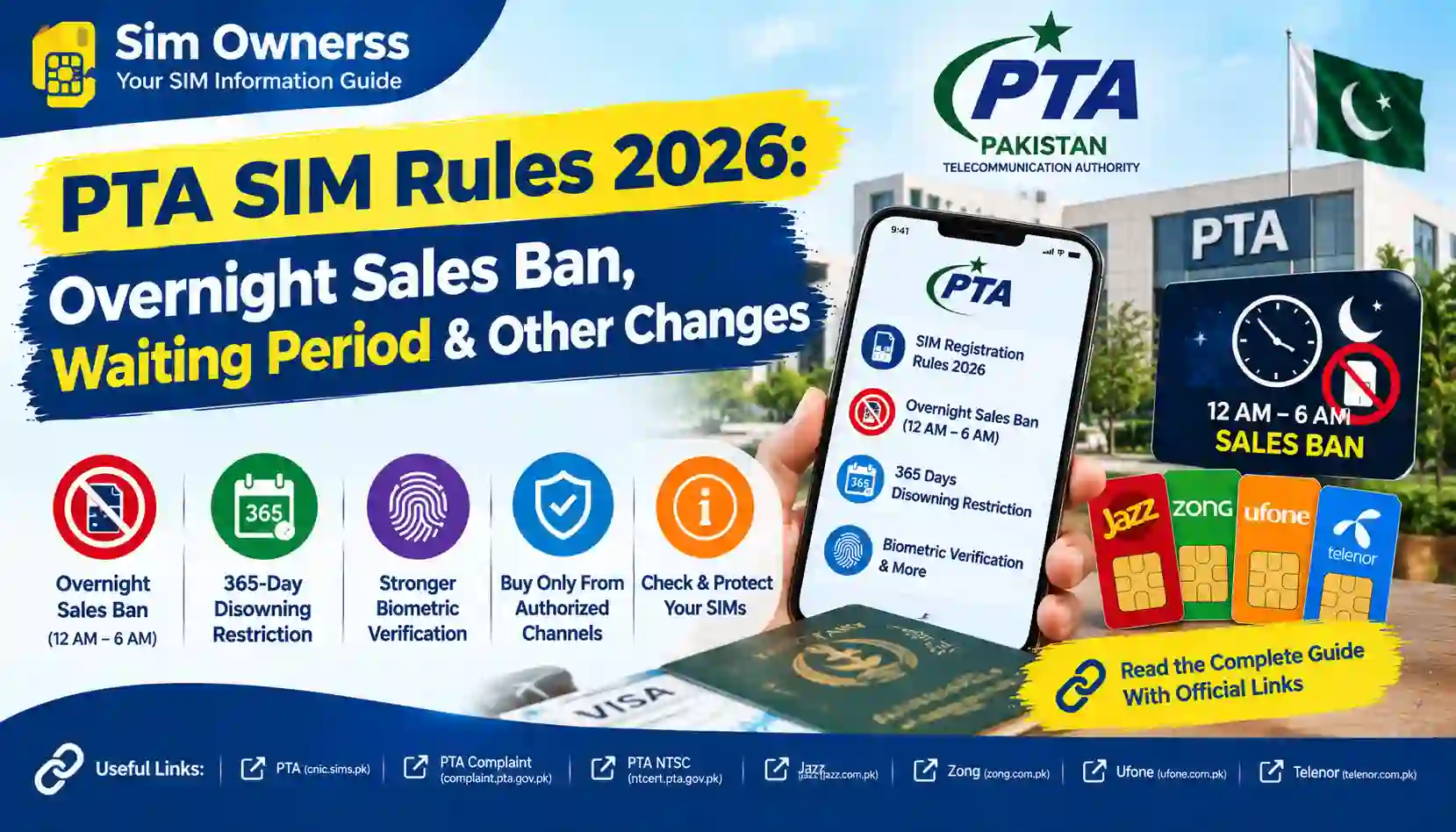
Learn the latest PTA SIM rules for 2026, including the midnight sales ban, 365-day disowning restriction, biometric verification and consumer safety tips.
The Pakistan Telecommunication Authority (PTA) has introduced stricter measures to improve SIM registration security and reduce the risk of unauthorized mobile connections. These changes are important for anyone purchasing a new SIM, transferring a number, replacing a lost SIM, or managing connections registered against their Computerized National Identity Card (CNIC).
The PTA SIM Rules 2026 have attracted attention for three main reasons: restrictions on SIM sales during late-night hours, an extended waiting period before certain newly activated SIMs can be disowned, and stronger requirements for biometric verification.
For mobile users, understanding these changes can help prevent registration mistakes, identity misuse, and unexpected difficulties when requesting a SIM ownership change.
This guide explains the reported rules, how they may affect ordinary customers, how to check SIMs registered against your CNIC, and what to do if a retailer or mobile operator does not follow the applicable requirements.
Important: Rules and procedures can differ depending on the service requested and the operator. Always confirm the latest requirements with the PTA or your mobile network before making a decision.
Quick Summary of PTA SIM Rules 2026
| Rule or change | What customers should know |
|---|---|
| Overnight SIM sales ban | SIM sales are to be suspended from 12:00 AM to 6:00 AM. |
| SIM disowning waiting period | The reported restriction has been extended from 60 days to 365 days for newly activated SIMs. |
| Biometric verification | SIM registration and specified SIM-related transactions require the prescribed verification process. |
| Authorized sales outlets | Buy SIMs through authorized operator channels rather than informal sellers. |
| CNIC SIM checks | Customers can check the total number of SIMs registered against their CNIC through the official PTA system. |
| Complaints | Suspected violations can be reported through the PTA Complaint Management System. |
These points summarize the reported changes, not a substitute for the applicable PTA directive or an operator’s current service terms.
1. PTA Overnight SIM Sales Ban: 12 AM to 6 AM
One of the most discussed changes is the restriction on selling SIM cards during late-night hours.
According to a public communication published by the PTA, cellular mobile operators were directed to suspend SIM sales across Pakistan between 12:00 AM and 6:00 AM. The instruction applies to authorized sales channels, including relevant franchises and retail outlets.
The measure is intended to strengthen oversight of SIM issuance and reduce opportunities for unauthorized or fraudulent registrations.
What does the overnight sales ban mean?
Under the reported instruction:
- SIM sales should not take place during the restricted hours.
- Customers should purchase SIMs through authorized outlets during permitted hours.
- Retailers and franchises must follow the applicable sales restrictions.
- Required identity and biometric checks must be completed before a connection is activated.
- Suspected violations can be reported to the relevant authorities.
The restriction concerns SIM sales. Customers should not automatically interpret it as a nationwide shutdown of all mobile services between midnight and 6 AM.
Can you buy a SIM after midnight?
You should not expect to purchase a new SIM through a sales outlet during the restricted period. Plan your visit to an authorized franchise or customer service centre during permitted hours.
If a retailer offers to bypass the restriction, avoid sharing your CNIC details or fingerprints through an informal process. Ask the operator to confirm its authorized procedure.
Why has PTA introduced this restriction?
SIM cards can be misused for scams, fraudulent account registrations, impersonation, and other unlawful activities. Controls on sales channels help regulators and operators monitor how new connections are issued.
However, the time restriction alone does not prevent every form of identity misuse. Customers should also verify their registered connections and avoid giving biometric verification for a transaction they do not understand.
2. The 365-Day SIM Disowning Waiting Period
Another significant change reported in 2026 concerns the waiting period for disowning certain newly activated SIMs.
Earlier reporting described a restriction period of 60 days. Under the revised policy, the period was extended to 365 days, or one year, for newly activated SIM cards.
This change is intended to strengthen safeguards against illegal SIM issuance and unauthorized registrations.
What does SIM disowning mean?
SIM disowning is the process of removing a mobile connection from your registered identity through the operator’s prescribed procedure.
It is different from simply switching off your phone, removing a SIM card, or stopping its use. A connection may remain registered against your identity until the relevant operator completes the required process.
Does the one-year rule mean you cannot block a SIM?
Do not assume that every request involving a SIM is subject to the same restriction.
The reported waiting period concerns disowning or transferring certain newly activated connections. Blocking a lost SIM, reporting suspected fraud, addressing unauthorized registration, and requesting a security investigation are different matters.
If a SIM has been issued against your CNIC without your permission, contact the operator and ask how to report the unauthorized registration. Explain the circumstances instead of treating the one-year period as a reason not to report the problem.
The operator or PTA should clarify which procedure applies to your particular case.
What should you do before purchasing a SIM?
Before completing registration:
- Confirm that the SIM is being issued through an authorized channel.
- Verify that the registration is being completed in your own name.
- Read the applicable terms concerning disowning and ownership changes.
- Keep the transaction receipt or other available confirmation.
- Do not provide biometric verification for an unexplained or incomplete transaction.
Practical tip: If you are unsure about the one-year restriction, ask the operator to explain its current policy before activating a new connection.
3. Biometric Verification Requirements for SIM Registration
Biometric verification remains a central part of SIM registration security in Pakistan.
The process helps an operator verify a customer’s identity against the prescribed identity-verification system before completing an eligible transaction.
Depending on the service and applicable rules, verification may be required for:
- Purchasing a new SIM.
- Obtaining a replacement for a lost or damaged SIM.
- Transferring SIM ownership.
- Disowning a SIM.
- Completing mobile number portability or another specified account transaction.
The exact requirements should be confirmed with the relevant operator.
Why is biometric verification important?
A SIM registered against your identity can create problems if someone else uses it improperly. Identity verification is intended to make unauthorized registration more difficult and help operators maintain reliable subscriber records.
Customers should nevertheless remain careful. A biometric request should be connected to a transaction they have deliberately initiated.
How to protect your biometric information
Follow these basic precautions:
- Visit an authorized franchise or customer service centre.
- Understand the purpose of the transaction before providing verification.
- Never allow an unknown person to use your identity details for an unexplained SIM registration.
- Do not share identity-document photographs with suspicious sellers.
- Ask for transaction confirmation when available.
- Report suspected misuse promptly.
For further safety guidance, consult the PTA’s National Telecom and Information Security Board resources on SIM security and identity protection.
4. SIMs Should Be Purchased Through Authorized Channels
Another important part of SIM security is the use of legitimate sales channels.
Customers should obtain SIMs from authorized operator franchises, service centres, and approved retailers. An informal seller may not provide the same safeguards or accountability as an authorized channel.
The PTA has also communicated stricter expectations for operators concerning SIM issuance and monitoring of sales channels.
Before you buy a new SIM
Use this checklist:
- Carry the original identity document required for your transaction.
- Confirm the outlet is authorized by the relevant operator.
- Complete the required verification process yourself.
- Check that the transaction is for the correct mobile number and service.
- Ask for proof of purchase or confirmation where available.
- Do not leave an outlet without understanding what was registered in your name.
Avoid offers promising a SIM without the prescribed identity checks. A seller’s assurance that verification is unnecessary should not be treated as proof that the transaction is legitimate.
What if a retailer sells a SIM illegally?
Keep any available evidence, such as a receipt, transaction message, retailer details, date, and time. Report the matter to the relevant mobile operator and, where appropriate, the PTA through its complaint channels.
Do not publish your complete CNIC number, fingerprints, or other sensitive identity information on social media while seeking help.
5. How to Check SIMs Registered Against Your CNIC
Checking your registered SIM count is a practical way to monitor your identity.
The official PTA SIM Information System allows users to check the total number of SIMs registered against a CNIC. Foreign nationals can use the Foreign ID option where applicable.
Method 1: Check online
Follow these steps:
- Open the official PTA SIM Information System.
- Select the appropriate identification option.
- Enter your CNIC or eligible Foreign ID details as requested.
- Complete the on-screen verification.
- Submit the form and review the displayed information.
The portal is intended to show the number of registered SIMs associated with the provided identity. Do not assume it will reveal another subscriber’s private name, address, call history, or confidential records.
Method 2: Use the 668 SMS service
You can also use the established SMS-based method to check the SIM count associated with your CNIC.
- Open your phone’s messaging application.
- Enter your CNIC number without dashes.
- Send it to 668.
- Review the response and follow any instructions provided.
Standard SMS charges may apply. If the service does not respond or the result seems incorrect, confirm the available process with your operator or the PTA.
What should you do if you find an unfamiliar registration?
If the count or network information raises concerns:
- Record the network and the information shown by the official service.
- Contact that operator through its official support channel.
- Explain that you suspect an unauthorized registration.
- Ask the operator to verify the connection and explain the applicable blocking, investigation, or disowning procedure.
- Keep the complaint reference and any written response.
- Escalate the matter through the PTA Complaint Management System if necessary.
Remember that a SIM-count result may not identify the exact mobile number or explain why a connection appears in the count. You may need assistance from the relevant operator.
6. What to Do If Someone Uses Your CNIC Without Permission
Discovering an unexpected SIM registration can be worrying, but it is important to act through the correct channels.
Step 1: Contact the mobile operator
Use the operator’s official helpline, website, or customer service centre. Explain that you believe a SIM may have been registered against your CNIC without authorization.
Ask what documents and verification are required to investigate the matter.
Step 2: Request the appropriate action
Depending on the circumstances, ask the operator to explain whether the case requires blocking, disowning, an ownership investigation, or another formal procedure.
Do not assume that the 365-day waiting period removes your right to report suspected identity misuse.
Step 3: Keep evidence
Save complaint numbers, text messages, receipts, and relevant communications. Do not alter evidence or share your sensitive personal information with unofficial agents.
Step 4: Escalate unresolved complaints
If the operator does not resolve the issue, you can submit a complaint through the PTA’s official Complaint Management System.
Clearly describe what happened, when you discovered it, which operator is involved, and what action you have already requested.
Step 5: Consider additional reporting if fraud occurred
If the SIM has been used for financial scams, impersonation, threats, or another suspected crime, consider reporting the incident to the appropriate law-enforcement or cybercrime authority as well.
The appropriate route depends on the nature of the incident. Keep your evidence and use official reporting channels.
7. Do the New PTA SIM Rules Affect Existing SIM Owners?
The impact depends on the rule and the transaction involved.
Existing customers
The overnight sales restriction primarily concerns SIM sales during the restricted hours. It should not be confused with a general ban on using existing mobile connections at night.
The reported 365-day restriction concerns the applicable disowning or transfer process for newly activated SIMs. It does not automatically mean every existing subscriber must register again.
People buying a replacement SIM
A replacement SIM is not necessarily treated in the same way as a new connection for every purpose. The operator may require identity verification and other checks before issuing the replacement.
Contact the relevant network if you have lost your SIM or suspect someone else is using it.
People transferring ownership
Before requesting an ownership transfer, confirm the operator’s current requirements and whether the waiting-period restriction applies to your connection.
Do not rely solely on social media posts or advice from an unofficial retailer.
People who discover unauthorized registrations
Report suspected misuse as soon as possible. A restriction on ordinary disowning or transfer requests should not be interpreted as a reason to ignore identity theft or a potential security problem.
8. How PTA SIM Rules 2026 Affect Mobile Users
The updated controls have practical implications for both customers and retailers.
| Situation | Recommended action |
|---|---|
| You want to purchase a new SIM | Visit an authorized outlet during permitted hours and complete verification. |
| You want to disown a recently activated SIM | Ask the operator how the reported 365-day restriction applies to your case. |
| You lose your phone or SIM | Contact your operator promptly to secure the connection. |
| Your CNIC shows an unexpected SIM count | Contact the relevant operator and request an investigation. |
| A retailer offers a SIM without proper verification | Avoid the transaction and report suspected misconduct. |
| Your complaint remains unresolved | Escalate it through the PTA’s official complaint system. |
| You are unsure which rule applies | Obtain confirmation from the PTA or the operator before proceeding. |
These measures are intended to strengthen SIM registration controls, but customers still need to monitor their own identity information and report suspicious activity.
9. Official Websites and Resources for SIM Verification
Use official sources when checking registration requirements or reporting problems.
PTA SIM Information System: Use the portal to check the total number of SIMs registered against your CNIC or the relevant foreign identity document.
PTA Complaint Management System: Use the official complaint portal to submit and track eligible telecommunications complaints.
PTA National Telecom and Information Security Board: Consult its security-awareness resources for guidance on SIM-related fraud, identity protection, and safe use of telecommunications services.
Your mobile network’s official website: Check current requirements for new SIM issuance, replacement SIMs, ownership changes, disowning, and customer complaints.
For general educational information and related guides, visit Sim Ownerss. This website is independently operated and is not an official PTA portal or government service.
10. Common Mistakes to Avoid Under the New Rules
Many SIM-related problems arise because customers misunderstand registration requirements or rely on unofficial advice.
Avoid these mistakes:
- Assuming you can buy a SIM at any time of day.
- Believing that a SIM-count check reveals every detail about a registered connection.
- Assuming the one-year restriction means suspected identity misuse cannot be reported.
- Providing fingerprints for a transaction you did not request.
- Buying a SIM from an unauthorized seller.
- Assuming that stopping the use of a SIM automatically removes it from your CNIC.
- Sharing CNIC photographs or personal information with unknown agents.
- Treating an unofficial social media post as a replacement for an official directive.
- Ignoring a complaint reference or failing to keep evidence of an unauthorized registration.
When in doubt, contact the operator directly and ask for the current procedure in writing where possible.
Frequently Asked Questions
1. What are the latest PTA SIM Rules 2026?
Reported changes include a restriction on SIM sales between midnight and 6 AM, an extension of the disowning waiting period for certain newly activated SIMs from 60 to 365 days, and stronger SIM verification and sales-channel controls.
2. What are the restricted hours for SIM sales in Pakistan?
The reported restriction covers 12:00 AM to 6:00 AM. Customers should purchase SIMs through authorized channels during permitted hours.
3. Can I disown a SIM before 365 days?
The reported policy extends the waiting period for disowning certain newly activated SIMs. Ask your operator whether the restriction applies to your specific transaction. Suspected unauthorized registration or fraud should still be reported promptly.
4. Does the 365-day rule apply to blocking a lost SIM?
Do not automatically treat blocking a lost SIM as the same process as disowning or transferring ownership. Contact your operator immediately to secure the connection and confirm the correct procedure.
5. How can I check SIMs registered on my CNIC?
Use the official PTA SIM Information System or send your CNIC number without dashes to 668. The service provides SIM-count information, subject to the service’s current availability and requirements.
6. Is biometric verification required for a new SIM?
SIM issuance is subject to the prescribed identity and biometric verification requirements. Confirm the exact process with your chosen operator before completing the transaction.
7. What should I do if an unauthorized SIM is registered against my CNIC?
Contact the relevant mobile operator, request an investigation, keep the complaint reference, and escalate the matter to the PTA if necessary. Report associated fraud to the appropriate authority.
8. Can a retailer sell a SIM after midnight?
Under the reported PTA instruction, SIM sales are to be suspended from 12 AM to 6 AM. Use authorized outlets during permitted hours and report suspected violations through official channels.
9. Does the overnight ban stop me from using my current SIM?
The reported restriction concerns SIM sales during late-night hours. It should not be interpreted as a general ban on using an already active SIM at night.
10. Where can I confirm the latest SIM rules?
Check the official PTA website, the PTA SIM Information System, the relevant operator’s official website, and the PTA Complaint Management System. These are more reliable than unverified social media posts.
Conclusion
The PTA SIM Rules 2026 highlight the importance of responsible SIM registration, identity verification, and monitoring connections registered against your CNIC.
The reported midnight-to-6 AM sales restriction affects when SIMs may be sold, while the revised 365-day waiting period can affect disowning or transferring certain newly activated connections. Biometric verification and authorized sales channels remain important safeguards.
If you are purchasing a SIM, verify your identity through the prescribed process. If you suspect unauthorized registration, contact the relevant operator and report the issue rather than ignoring it because of the waiting period.
Use official resources to verify current requirements, keep records of complaints, and avoid sharing sensitive identity information with unofficial sellers.
Disclaimer
This article is for general educational and informational purposes. It is not legal advice and does not represent an official statement from the Pakistan Telecommunication Authority, NADRA, or any mobile network operator. Regulatory instructions and operator procedures may change. Confirm the applicable requirements with the relevant official source before acting.
About Sim Ownerss: Sim Ownerss is an independently operated informational website that publishes educational guides about SIM registration, verification, and mobile security in Pakistan. It is not affiliated with or endorsed by the PTA, NADRA, or any government department.