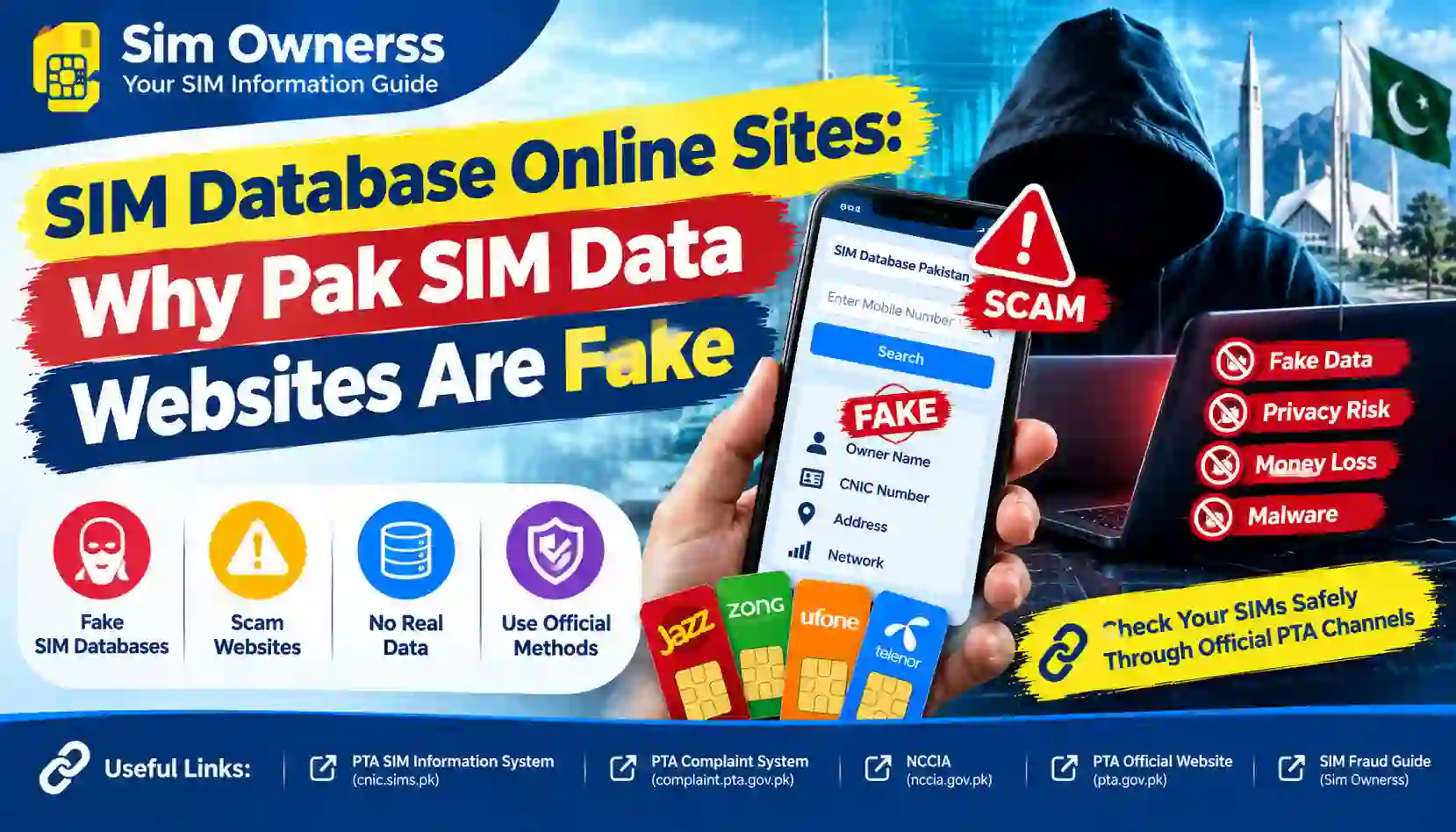
Learn why fake SIM database websites are risky, how to spot Pak SIM data scams, and how to check your own registered SIMs through official PTA methods.
Searching for a mobile number online can lead you to websites claiming to provide complete SIM owner details, CNIC information, addresses, and other personal records. These websites often use phrases such as Pak SIM Data, SIM Database Online, Live SIM Database, and SIM Owner Details to attract people looking for information about a Pakistani mobile number.
But there is an important distinction between an official SIM-verification service and a website that claims it can reveal another person’s private information.
A website claiming to reveal anyone’s SIM owner name, CNIC number, or address should not be trusted simply because it uses the words “database,” “official,” or “PTA.” A professional-looking page is not proof that its information is genuine or that the service is authorized.
The Pakistan Telecommunication Authority (PTA) provides an official SIM Information System for checking the number of SIMs registered against your own CNIC. It does not function as a public directory for looking up another person’s private subscriber records. You can access the official system through the PTA SIM Information System.
At Sim Ownerss, our goal is to help readers understand SIM registration, protect their personal information, and use legitimate verification methods. This guide explains why suspicious SIM database websites can be misleading, how to recognize common warning signs, and what you should use instead.
What Are SIM Database Online Sites?
SIM database online sites are websites or applications that advertise access to mobile-number-related information. Depending on their claims, they may promise to show:
- The name associated with a mobile number.
- A person’s CNIC number.
- The mobile network associated with a number.
- An address or other personal details.
- Information about SIMs registered against an identity.
- Downloadable databases containing subscriber records.
These claims are not all equivalent. For example, identifying a mobile network may be possible through legitimate telecom services, while revealing another subscriber’s private identity details is a different matter.
Some websites may display public or general information, collect user-submitted data, show outdated records, or present fabricated results. Others may use misleading advertisements to encourage visitors to share personal information or install an application.
The key question is not whether a website calls itself a SIM database. The key question is whether the service is official, what information it is authorized to provide, and how it obtains that information.
A name or CNIC displayed on an unofficial page should never be treated as verified proof of SIM ownership.
Why Are Pak SIM Data Websites Often Misleading?
Websites using terms such as “Pak SIM Data” or “SIM Database Online” may make promises that cannot be verified from their public pages.
Not every third-party website has the same purpose, and it would be inaccurate to label every site using these words a scam without examining it. However, websites claiming to provide unrestricted access to private subscriber records are a serious red flag.
Here are the main reasons to be cautious.
1. They may promise access to private subscriber information
Some websites claim that entering any Pakistani mobile number will reveal the subscriber’s name, CNIC, or home address.
Before trusting such a claim, ask whether the website identifies an official legal basis for providing that information. Does it belong to a recognized telecom operator or government department? Does an official source confirm the service?
The existence of a telecom registration system does not mean that its records are available for unrestricted public searches.
Telecom operators and authorized systems maintain subscriber information for legitimate operational and regulatory purposes. That is different from offering a public search engine for another person’s private records.
2. Their results may be inaccurate or outdated
A website may display information copied from an old source, submitted by users, or obtained without a reliable verification process.
Even if a displayed name looks realistic, it may not belong to the current subscriber of the number. Mobile numbers can change hands, records can become outdated, and unofficial datasets may contain errors.
Never use an unverified online result as the sole basis for accusing someone, making a financial decision, or deciding who owns a mobile number.
3. They may collect your personal information
Some suspicious websites use a lookup form to encourage visitors to enter phone numbers, CNIC details, or other sensitive information.
A form that appears to be checking a database may instead be collecting the information entered into it. The website may not explain clearly who operates the service, why the information is needed, or how long it will be retained.
Providing someone else’s number can also expose that person’s information to an unknown service.
For your own protection, avoid entering sensitive identity details into websites that cannot establish their legitimacy.
4. They may use fake loading screens
A common warning sign is a page that shows messages such as:
- “Connecting to the live database.”
- “Searching all Pakistani SIM records.”
- “Retrieving owner CNIC.”
- “Unlocking private SIM details.”
- “Database found — complete verification.”
A loading animation is not proof that a real database search is taking place.
Some pages may display a generic result regardless of the number entered. Others may send visitors through advertisements, surveys, or repeated verification screens.
If a website keeps demanding another step before revealing a supposed result, leave the page rather than supplying more information.
5. They may encourage suspicious downloads
A website may ask you to install an APK file or an application outside a trusted app store to access a supposed SIM database.
An application requesting access to contacts, SMS messages, call logs, or other sensitive permissions deserves careful scrutiny. These permissions can expose information stored on your device.
Do not install an unknown application simply because a website claims it is necessary to reveal SIM owner details.
6. They may impersonate official organizations
A suspicious website may use a government-style logo, official-sounding language, or a domain name containing terms such as “PTA,” “SIM,” or “database.”
These design choices do not establish an official connection.
If a page claims to be a government service, find the service independently through the organization’s official website. Do not rely on a link provided by an unknown caller, social media account, or suspicious advertisement.
The PTA has previously warned consumers about deceptive links that falsely claimed to be associated with its services. Its public guidance emphasizes using official platforms and avoiding suspicious links.
Read the related warning from the Associated Press of Pakistan.
Official PTA SIM Information System vs. Unofficial Database Websites
The safest way to understand the difference is to compare what an official service actually provides with what an unverified website claims to offer.
| Feature | Official PTA SIM Information System | Unofficial SIM database website |
|---|---|---|
| Main purpose | Check SIM counts associated with your own identity | May advertise various lookup services |
| Information requested | Your own CNIC or eligible foreign identity document | May request a mobile number, CNIC, or other details |
| Results | SIM-count information associated with the submitted identity | Claims may be unverified or misleading |
| Government affiliation | Official PTA SIM Information System | Must be independently verified |
| Privacy expectations | Use the official service according to its instructions | Data handling may be unclear |
| Payment or download | Use the official service as presented | Be cautious of unlock fees and unknown downloads |
| Best practice | Use for your own authorized verification | Do not trust claims about private records without reliable evidence |
The official portal states that users can enter a CNIC to find the total number of SIMs registered against it. It also provides a Foreign ID option for eligible foreign nationals.
Visit the official PTA SIM Information System directly rather than following a random link from a social media post.
What Can You Actually Check Through the Official PTA System?
The official SIM Information System is useful when you want to review the number of SIMs registered against your own identity.
It is not designed to reveal the private details of any person whose mobile number you happen to know.
Method 1: Check your SIM count online
Follow these steps:
- Open the official PTA SIM Information System.
- Select the CNIC option for your own Pakistani identity, or the appropriate Foreign ID option where applicable.
- Enter the requested identity number.
- Complete the on-screen verification.
- Submit the form and review the result.
The result helps you understand the SIM registrations associated with your identity. It should not be confused with a public directory of mobile-number owners.
If you discover an unexpected registration, contact the relevant mobile operator and ask it to investigate.
Method 2: Use the 668 SMS service
PTA has also advised consumers to check their registered SIMs through the 668 SMS service.
To use it:
- Open the messaging application on your phone.
- Type your CNIC number without dashes.
- Send the message to 668.
- Read the response and follow any instructions provided.
Standard SMS charges may apply. If the response is delayed or unclear, confirm the current process with your operator or the PTA.
For a detailed walkthrough, add an internal link to your article titled “How to Use 668 SMS Service to Check SIMs on Your CNIC.”
What if you need to identify an unknown caller?
A SIM-count check will not reveal another person’s confidential subscriber details. If you receive a threatening call, suspicious message, or scam attempt, preserve the evidence and report the incident through the appropriate official channel.
Do not rely on a third-party database result as proof of identity.
Seven Warning Signs of a Fake SIM Database Website
Before entering any information, review the website carefully.
1. It promises anyone’s CNIC or home address
A public lookup service claiming it can reveal another subscriber’s private identity details should be treated as suspicious unless its authority and legal basis can be independently confirmed.
2. It claims to have every network’s complete live database
Broad claims such as “all networks, all owners, all records” are not evidence that a website has legitimate access to telecom records.
Ask for a verifiable official source rather than trusting a slogan.
3. It demands payment to unlock a result
A page may initially promise a free lookup and later demand payment, a mobile balance transfer, or a subscription to reveal the supposed result.
Do not pay an unknown service simply because it displays a name or a progress bar.
4. It forces you to share a link
If the website requires you to forward a link to WhatsApp groups or contacts before showing a result, leave the page. This can be a tactic for spreading the website rather than providing a legitimate service.
5. It requires an unknown APK
Avoid downloading files from websites that cannot be verified. Unknown applications may expose your data or compromise your device.
6. It has no clear operator or privacy information
Look for a real organization name, contact information, privacy policy, and an explanation of the service. Missing details do not automatically prove fraud, but they make it harder to establish trust.
7. It uses fake official branding
A logo or government-style layout can be copied. Check the domain independently and look for confirmation on the organization’s actual website.
Safety rule: If a website promises private information, demands unnecessary personal data, and cannot prove that it is authorized, do not use it.
How Fake SIM Database Websites Can Put You at Risk
Using an unreliable lookup service may create risks beyond receiving an incorrect result.
Identity information exposure
If you enter your CNIC or other identifying details, you may be giving that information to an unknown operator. This can increase the risk of unwanted contact, impersonation attempts, or targeted scams.
Financial scams
A page may ask for a small fee to unlock a result, then request additional payments or redirect you to an unrelated payment page.
Never provide card details, banking credentials, wallet PINs, or OTPs to an unverified SIM database service.
Malware and unsafe applications
An unknown APK may request permissions unrelated to its advertised purpose. Installing it could expose contacts, messages, files, or other information depending on the permissions granted and the app’s behavior.
False accusations
A website may display incorrect information about a number. Acting on that information without independent confirmation can lead to disputes or harm an innocent person.
Further phishing attempts
Information submitted to an untrustworthy service may be used to create more convincing scam messages or calls.
These are potential risks, not proof that every third-party site engages in every practice. The important point is to avoid giving sensitive data to services you cannot verify.
What to Do If You Have Already Used a Fake SIM Database Website
If you have already entered information into a suspicious website, do not panic. Take action based on what you shared.
If you entered your CNIC
Avoid submitting additional personal information. Monitor for suspicious calls or messages, and review your own SIM registrations through the official PTA system.
If you suspect unauthorized SIM registration, contact the relevant operator and request an investigation.
If you entered a password
Change that password immediately from the service’s official website or application. If you reused the same password elsewhere, change it on those accounts as well.
Enable additional authentication where available.
If you shared an OTP
Contact the relevant service provider immediately, especially if the code related to a banking, email, messaging, or financial account. Review account activity and follow the provider’s recovery instructions.
Never share any further codes with the website operator or an unsolicited caller.
If you installed an unknown application
Review the app’s permissions, remove it if you do not trust it, and run the security checks available on your device. If you entered account credentials through the app, change them from a trusted device.
For a serious compromise, seek assistance from a reputable cybersecurity professional.
If you made a payment
Contact your bank, card issuer, or payment provider promptly. Explain that you may have paid a fraudulent service and ask whether the transaction can be disputed or further payments blocked.
Keep receipts, screenshots, and transaction references.
If the website impersonated PTA
Preserve the URL, screenshots, messages, and any available payment details. Report the suspected deception through the PTA’s official complaint channels.
You can access the PTA Complaint Management System for telecommunications-related complaints.
How to Report SIM-Related Fraud in Pakistan
The appropriate reporting route depends on what happened.
Report unauthorized SIM registration to the mobile operator
If you find a SIM you do not recognize in your own registration information, contact the relevant network through its official helpline or customer service centre.
Explain the problem and ask for the prescribed investigation, blocking, or disowning procedure. Keep your complaint reference.
Report a telecommunications complaint to PTA
If the operator does not address your issue, use the PTA Complaint Management System.
Include relevant details, such as the operator, the approximate date, a description of the issue, and any previous complaint reference. Submit sensitive documents only through the official process when required.
Report suspected cybercrime
If a fake website has stolen account credentials, impersonated you, or been involved in online fraud, consult the National Cyber Crime Investigation Agency for the appropriate reporting procedure.
If money has been taken, contact your bank or payment provider immediately as well.
Preserve evidence
Save screenshots, website addresses, messages, receipts, and complaint numbers. Avoid publishing your complete CNIC, bank details, or private communications on public social media.
Safe Alternatives to Unofficial SIM Database Websites
You do not need an unverified website to manage your own SIM security.
Use the official source that matches your actual need.
| Your need | Safer option |
|---|---|
| Check SIMs registered against your CNIC | PTA SIM Information System |
| Check your own SIM count by SMS | Send your CNIC without dashes to 668 |
| Investigate an unfamiliar registration | Contact the relevant mobile operator |
| Report an unresolved telecom complaint | PTA Complaint Management System |
| Report suspected online fraud | Consult the NCCIA official website |
| Learn about SIM registration and security | Read educational guides on Sim Ownerss and confirm procedures with official sources |
The right choice depends on whether you are checking your own SIM count, investigating unauthorized registration, or reporting an actual scam.
Why Responsible SIM Verification Matters
SIM registration is connected to identity verification and subscriber accountability. PTA has advised users to ensure that SIMs are registered in their own names and to check the registrations associated with their CNIC.
This matters because an improperly registered connection can create problems for both the person using the SIM and the person whose identity is attached to it.
Responsible SIM verification includes:
- Checking your own registered SIM count periodically.
- Using SIMs registered according to the applicable requirements.
- Reporting connections you do not recognize.
- Completing SIM-related transactions through authorized channels.
- Avoiding unofficial services that promise private subscriber details.
- Protecting your CNIC and verification codes.
You can read the PTA’s SIM registration guidance reported by the Associated Press of Pakistan for further context.
Frequently Asked Questions
1. Are SIM Database Online Sites real or fake?
Some websites may provide general information or legitimate services, but claims that a website can reveal any person’s private SIM owner details should be treated with caution. Verify the service’s authorization and use official channels for your own SIM checks.
2. Is Pak SIM Data an official PTA website?
Do not assume that a site is official simply because it uses the phrase “Pak SIM Data.” The official PTA SIM Information System is available at cnic.sims.pk. Verify any other service independently before sharing information.
3. Can I check the name of a SIM owner online?
The official PTA SIM Information System is designed to show the number of SIMs registered against your own identity, not to provide a public search for another subscriber’s name or CNIC. For a safety or fraud concern, contact the relevant operator or authorities.
4. How can I check SIMs registered against my CNIC?
Use the official PTA SIM Information System or send your CNIC number without dashes to 668. Follow the current instructions provided by the official service.
5. Do fake SIM database websites steal CNIC information?
An untrustworthy website may collect information submitted by visitors, but its behavior cannot be determined from its name alone. Avoid entering CNIC details unless you have independently verified the website and understand why the information is required.
6. Is it safe to download a SIM database APK?
Do not install an unknown APK simply to access a supposed SIM lookup service. Review the app’s source and requested permissions carefully. A website promising private subscriber information is not proof that its app is safe or legitimate.
7. What should I do if a SIM is registered against my CNIC without my permission?
Contact the relevant mobile operator and request an investigation. Keep the complaint reference and escalate the matter to the PTA if needed.
8. Can a SIM database website reveal someone’s live location?
Do not trust a website claiming it can track a person’s live location from a mobile number without a legitimate, authorized basis. Such claims may be deceptive and can pose privacy and security risks.
9. Is the PTA SIM Information System free?
The official online portal can be used to check SIM counts against your identity. The SMS service to 668 may involve standard charges. Confirm the current terms through the official service.
10. Where can I report a fake website pretending to be PTA?
Preserve the website address and any relevant messages, then use the PTA’s official complaint channels for the appropriate report. If you suffered account compromise or financial fraud, contact the affected provider and consult the relevant cybercrime reporting authority.
Conclusion
SIM Database Online Sites can be tempting when you want to identify a mobile number quickly. However, a website that promises unrestricted access to subscriber names, CNIC numbers, addresses, or other private information should never be trusted without strong, verifiable evidence of its legitimacy.
The safest approach is simple: use the official PTA SIM Information System to check your own registered SIM count, contact your mobile operator about unfamiliar registrations, and report suspicious websites through the appropriate channels.
Do not enter sensitive identity information into unknown forms, install unverified SIM database applications, or pay a website merely because it displays a convincing result.
Protect your identity by choosing verified services over promises of instant private information.
About Sim Ownerss
Sim Ownerss is an independently operated educational website that publishes guides about SIM verification, registration procedures, and mobile security in Pakistan. It is not affiliated with or endorsed by the PTA, NADRA, or any government department.
Disclaimer
This article is intended for general educational and public-awareness purposes. It is not legal advice and does not accuse any specific third-party website of fraud without independent evidence. Website services and regulatory procedures can change. Always verify the current requirements through official sources before taking action.